Averages hide different reasons for staying
An overall engagement score or turnover rate can conceal both strong attachment and reluctant persistence. Read the distribution and the reasons behind it.
 People Potential
 Frameworks
Helping leaders make smarter retention investment decisions.
Understand why people stay, whether they can leave, and where leadership investment can make a meaningful difference.
Explore the framework ↓01 — Overview
Two people may stay with the same organisation for very different reasons. One values the work and actively chooses to remain. Another feels disconnected but sees no realistic alternative. A retention figure alone cannot tell those stories apart.
The Attachment–Mobility Framework brings together two dimensions: attachment, the strength of someone’s connection to the organisation, and mobility, their practical ability to leave for an external opportunity.
Together they create four situations requiring different leadership responses. The decision is to understand the situation, identify a credible intervention, and assess whether the expected benefit justifies the investment.
Use the framework in talent reviews, stay conversations and workforce planning. Positions are working hypotheses to revisit with evidence, not permanent labels for people.
02 — Why Traditional Retention Approaches Fail
An overall engagement score or turnover rate can conceal both strong attachment and reluctant persistence. Read the distribution and the reasons behind it.
A bonus may matter to one person while another needs a credible career path, a manageable workload or a repaired working relationship.
A resignation can attract attention and money that earlier conversations might have directed more effectively. Examine importance and the likely effect of intervention together.
Keeping a person does not establish that contribution, trust or the working relationship improved. Define the outcome the investment is meant to achieve.
Retention Return on Investment (RROI) makes the assumptions explicit: what benefit do we expect, at what cost, over what period?
03 — Framework
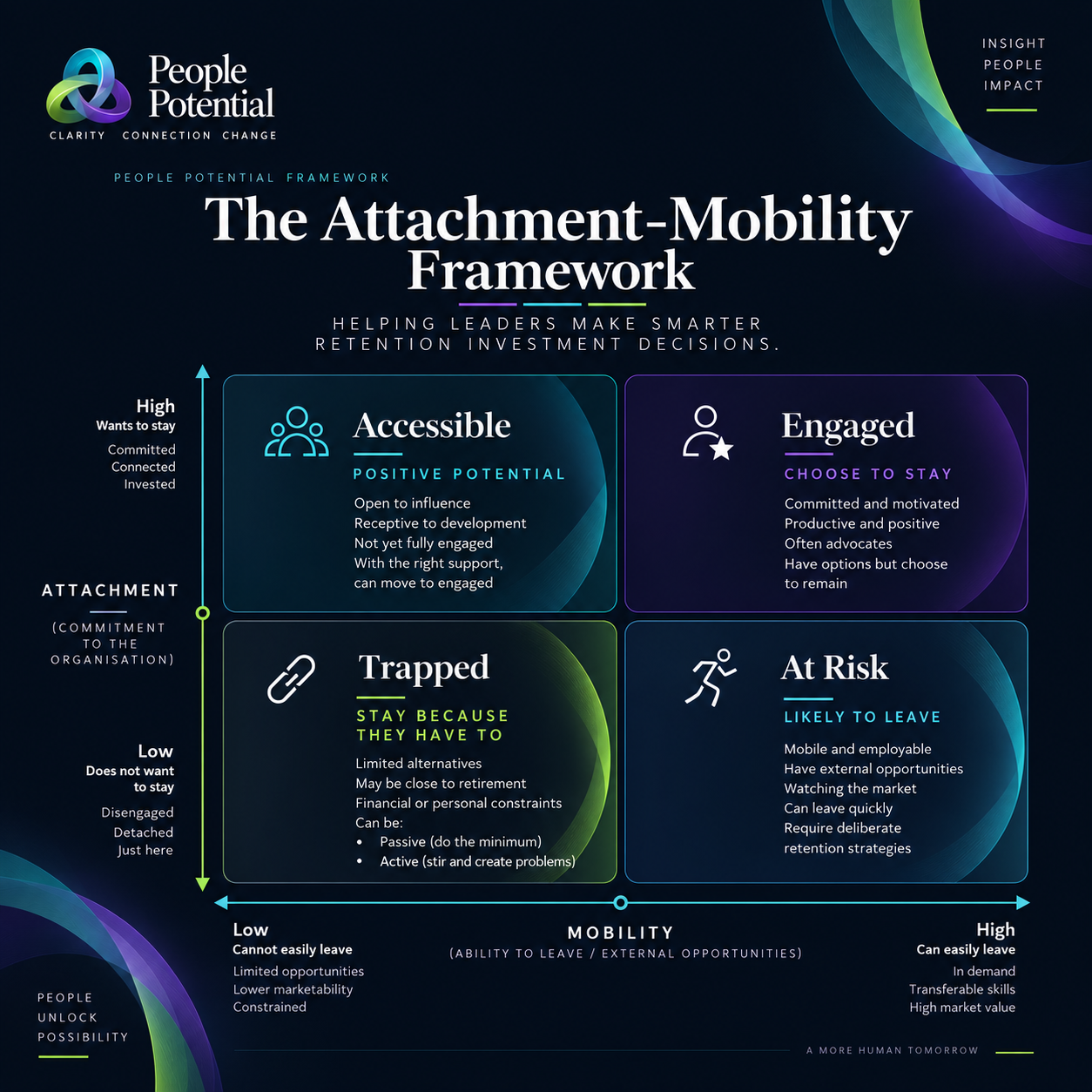
Do I want to stay? Explore connection to the organisation through the experience of the work, leadership, purpose, relationships and future opportunity.
Can I realistically leave? Explore external opportunities, transferable capability and practical constraints, using the individual’s account and relevant evidence.
An Accessible employee can become more committed while remaining in the same quadrant. Moving into the upper-right quadrant also requires higher mobility. The objective is stronger attachment and worthwhile contribution, not moving every person into one box.
04 — Understanding the Four Quadrants
01 · Higher attachment · Lower mobility
Positive potential
People who are positively disposed towards the organisation but have fewer realistic external options. Their connection may still need nurturing. They are receptive to clarity, development and a better everyday experience.
02 · Higher attachment · Higher mobility
Choose to stay
People with realistic alternatives who currently choose to remain. The framework uses Engaged to describe this combination of attachment and choice; it is not a performance rating.
03 · Lower attachment · Lower mobility
Stay because they feel they have to
People who feel little connection to the organisation and perceive few realistic alternatives. Continued service can conceal unresolved problems. Understand their experience before deciding what support or action is appropriate.
Withdrawal may appear as reduced initiative or doing only what is required. Explore clarity, capacity and the working experience before attributing motive.
Disconnection may coexist with behaviour that undermines colleagues or delivery. Identify specific actions and their impact. Constructive challenge, disagreement or raising a concern is not itself evidence of harmful disengagement.
04 · Lower attachment · Higher mobility
Able to leave, with weaker reasons to stay
People whose external options are credible and whose connection to the organisation has weakened. Their departure may be more feasible, but the quadrant does not predict when or whether they will leave.
No quadrant establishes someone’s performance, potential or worth. Age, retirement proximity, health or personal commitments alone cannot establish either attachment or mobility.
05 — Leadership Decision Matrix
Combine quadrant position with role importance, current contribution, future capability and the likelihood that a specific intervention will help.
| Situation | Leadership priority | Investment decision | Review evidence |
|---|---|---|---|
| Accessible | Develop and strengthen connection | Try targeted clarity, recognition and growth support; scale what works. | Attachment, agreed contribution and usefulness of support. |
| Engaged | Sustain the reasons to stay | Protect valued conditions; invest further where role and contribution warrant it. | Continued choice to stay, progress and emerging friction. |
| Trapped — passive | Understand and restore contribution | Agree a bounded support or role-fit plan with clear expectations. | Participation, delivery and whether the underlying issue is improving. |
| Trapped — active | Address causes and specific harmful conduct | Support repair where credible; use established processes for unresolved behaviour. | Observed conduct, impact on others and delivery against expectations. |
| At Risk | Decide whether retention is both desirable and feasible | Retain selectively when the cause is addressable; otherwise prepare continuity. | Whether concerns resolve, intent changes and handover risk reduces. |
06 — Economics of Retention
Compare the proposed intervention with what is likely to happen without it, over the same time period. Count the full cost of money, manager time, development and implementation. Include only benefits the intervention can reasonably influence.
Potential benefits include avoidable recruitment and vacancy costs, reduced disruption, preserved knowledge and improved contribution. Keep overlapping benefits separate to avoid counting the same value twice.
A practical planning calculation
RROI = (expected incremental benefit − intervention cost) ÷ intervention cost × 100
This is a decision aid with explicit assumptions, not a validated prediction from quadrant position. Use ranges when the evidence is uncertain.
An intervention costs R20,000. Assume it reduces the probability of an avoidable departure from 40% to 25%. Assume the net avoidable departure cost is R200,000.
Expected benefit: (40% − 25%) × R200,000 = R30,000.
Expected net benefit: R30,000 − R20,000 = R10,000. Illustrative RROI: 50%.
If the intervention reduces departure probability by only five percentage points, the expected benefit falls to R10,000 and RROI becomes −50%.
The break-even reduction is 10 percentage points. The decision depends on whether the intervention can credibly achieve that change.
All figures and probabilities are hypothetical. They are not benchmarks or claimed results.
Also consider fairness, team impact and whether the proposed future is desirable for both parties. Record important benefits that cannot be responsibly reduced to a monetary figure.
07 — Leadership Questions
08 — Relationship to Other People Potential Frameworks
Clarifies what the organisation must take care of and how Create, Enable and Execute contribute. It gives retention decisions their organisational context: which capabilities matter, what contribution is needed, and who owns the response.
Explore the Purpose Framework →Connects individual and organisational expectations through shared clarity, enablement and opportunity. It provides practical conversations for addressing development, contribution and future prospects that may be weakening attachment.
Explore Growth Potential →Use the frameworks together to move from organisational intent to an individual conversation, then to an owned and reviewable decision.